Professional Certificate in Data Science Harvardx Review or Coursea
by David Venturi
A year agone, I dropped out of one of the all-time computer science programs in Canada. I started creating my ain data scientific discipline principal's program using online resources. I realized that I could learn everything I needed through edX, Coursera, and Udacity instead. And I could learn information technology faster, more efficiently, and for a fraction of the toll.
I'1000 almost finished now. I've taken many information science-related courses and audited portions of many more. I know the options out there, and what skills are needed for learners preparing for a information analyst or data scientist function. A few months ago, I started creating a review-driven guide that recommends the best courses for each subject within data science.
For the first guide in the series, I recommended a few coding classes for the beginner data scientist. And then it was statistics and probability classes.
Now onto introductions to data science.
(Don't worry if yous're unsure of what an intro to data science course entails. I'll explain before long.)
For this guide, I spent 10+ hours trying to identify every online intro to data science class offered as of January 2017, extracting key bits of data from their syllabi and reviews, and compiling their ratings. For this chore, I turned to none other than the open source Class Central community and its database of thousands of form ratings and reviews.
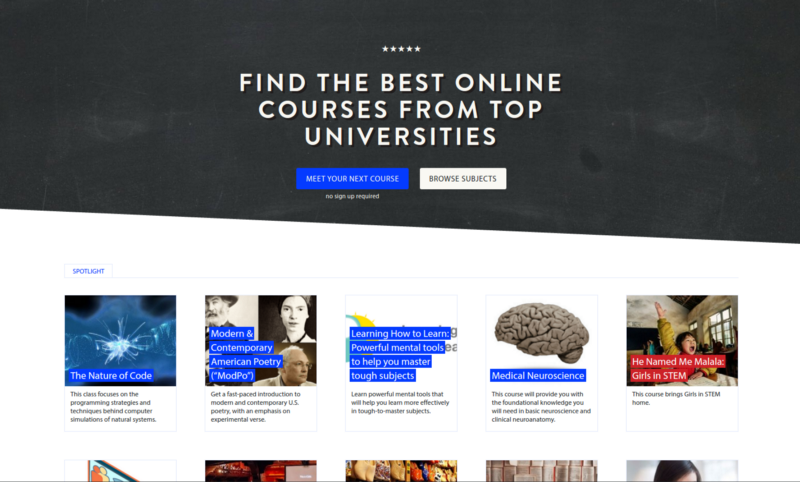
Since 2011, Class Primal founder Dhawal Shah has kept a closer eye on online courses than arguably anyone else in the world. Dhawal personally helped me assemble this list of resources.
How we picked courses to consider
Each course must fit three criteria:
- It must teach the data science process. More than on that soon.
- Information technology must be on-demand or offered every few months.
- It must be an interactive online class, then no books or read-just tutorials. Though these are feasible ways to learn, this guide focuses on courses.
Nosotros believe we covered every notable course that fits the above criteria. Since there are seemingly hundreds of courses on Udemy, we chose to consider the most-reviewed and highest-rated ones but. There'southward always a chance that nosotros missed something, though. And then delight let us know in the comments section if we left a good course out.
How we evaluated courses
We compiled average rating and number of reviews from Class Cardinal and other review sites to calculate a weighted average rating for each class. We read text reviews and used this feedback to supplement the numerical ratings.
We made subjective syllabus judgment calls based on 2 factors:
ane. Coverage of the data science procedure. Does the course brush over or skip certain subjects? Does information technology comprehend certain subjects in too much detail? See the side by side department for what this process entails.
2. Usage of common information science tools. Is the course taught using popular programming languages like Python and/or R? These aren't necessary, only helpful in nigh cases so slight preference is given to these courses.
What is the information science process?
What is data science? What does a data scientist practice? These are the types of fundamental questions that an intro to data scientific discipline form should respond. The following infographic from Harvard professors Joe Blitzstein and Hanspeter Pfister outlines a typical data science process, which will assist u.s. answer these questions.
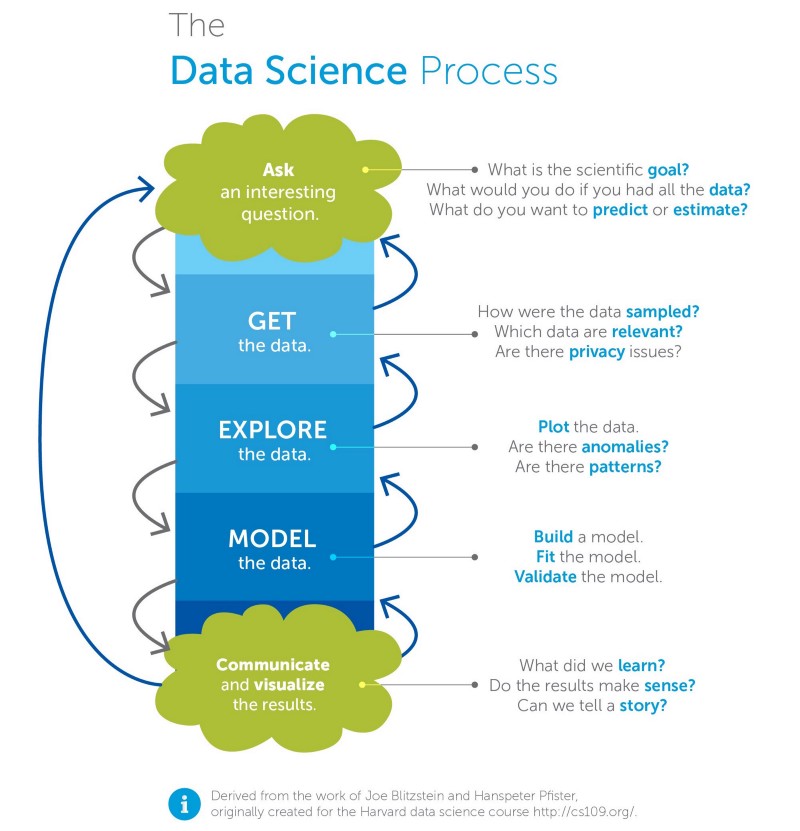
Our goal with this introduction to data science class is to become familiar with the data science procedure. We don't want too in-depth coverage of specific aspects of the procedure, hence the "intro to" portion of the title.
For each attribute, the platonic class explains key concepts within the framework of the process, introduces common tools, and provides a few examples (preferably hands-on).
We're only looking for an introduction. This guide therefore won't include total specializations or programs like Johns Hopkins University's Data Scientific discipline Specialization on Coursera or Udacity's Data Annotator Nanodegree. These compilations of courses elude the purpose of this serial: to observe the all-time private courses for each field of study to incorporate a data science education. The final three guides in this series of articles will embrace each aspect of the data science process in detail.
Basic coding, stats, and probability experience required
Several courses listed below require bones programming, statistics, and probability experience. This requirement is understandable given that the new content is reasonably avant-garde, and that these subjects often have several courses dedicated to them.
This experience can exist acquired through our recommendations in the first two articles (programming, statistics) in this Data Science Career Guide.
Our pick for the best intro to data science course is…
- Data Science A-Z™: Real-Life Data Scientific discipline Exercises Included (Kirill Eremenko/Udemy)
Kirill Eremenko'southward Data Science A-Z™ on Udemy is the articulate winner in terms of breadth and depth of coverage of the data science process of the 20+ courses that qualified. It has a 4.five-star weighted average rating over 3,071 reviews, which places it amongst the highest rated and well-nigh reviewed courses of the ones considered.
Information technology outlines the total process and provides real-life examples. At 21 hours of content, it is a good length. Reviewers beloved the instructor'southward commitment and the organisation of the content. The cost varies depending on Udemy discounts, which are frequent, then you may be able to purchase access for as little as $10.
Though it doesn't check our "usage of common data scientific discipline tools" box, the not-Python/R tool choices (gretl, Tableau, Excel) are used effectively in context. Eremenko mentions the following when explaining the gretl choice (gretl is a statistical software packet), though it applies to all of the tools he uses (emphasis mine):
In gretl, we will exist able to practise the same modeling but like in R and Python only we won't have to code. That'due south the big deal here. Some of you may already know R very well, merely some may non know it at all. My goal is to show y'all how to build a robust model and requite you a framework that you can apply in any tool you choose. gretl will assistance usa avert getting bogged down in our coding.
One prominent reviewer noted the post-obit:
Kirill is the best instructor I've found online. He uses real life examples and explains common problems and then that y'all get a deeper understanding of the coursework. He also provides a lot of insight every bit to what it means to be a information scientist from working with bereft information all the mode to presenting your work to C-class management. I highly recommend this course for beginner students to intermediate information analysts!
A great Python-focused introduction
- Intro to Information Analysis (Udacity)
Udacity's Intro to Data Analysis is a relatively new offering that is office of Udacity's popular Data Analyst Nanodegree. It covers the data science process clearly and cohesively using Python, though information technology lacks a bit in the modeling aspect. The estimated timeline is 36 hours (half-dozen hours per week over 6 weeks), though it is shorter in my experience. It has a five-star weighted average rating over two reviews. It is free.
The videos are well-produced and the instructor (Caroline Buckey) is clear and personable. Lots of programming quizzes enforce the concepts learned in the videos. Students will go out the course confident in their new and/or improved NumPy and Pandas skills (these are pop Python libraries). The last projection — which is graded and reviewed in the Nanodegree simply not in the gratuitous individual course — can be a nice add to a portfolio.

An impressive offering with no review data
- Data Science Fundamentals (Big Data University)
Data Scientific discipline Fundamentals is a iv-course series provided past IBM's Big Information University. Information technology includes courses titled Data Science 101, Data Science Methodology, Information Science Easily-on with Open Source Tools, and R 101.
It covers the full data scientific discipline process and introduces Python, R, and several other open-source tools. The courses have tremendous product value. thirteen–18 hours of attempt is estimated, depending on if you take the "R 101" class at the end, which isn't necessary for the purpose of this guide. Unfortunately, information technology has no review data on the major review sites that we used for this analysis, so we can't recommend it over the above two options withal. Information technology is costless.
The competition
Our #1 pick had a weighted average rating of 4.5 out of 5 stars over 3,068 reviews. Allow's look at the other alternatives, sorted by descending rating. Below you'll find several R-focused courses, if you lot are ready on an introduction in that language.
- Python for Data Science and Automobile Learning Bootcamp (Jose Portilla/Udemy): Full process coverage with a tool-heavy focus (Python). Less process-driven and more of a very detailed intro to Python. Astonishing course, though not ideal for the scope of this guide. It, like Jose's R grade below, can double as both intros to Python/R and intros to data science. 21.5 hours of content. Information technology has a 4.vii-star weighted average rating over 1,644 reviews. Toll varies depending on Udemy discounts, which are frequent.
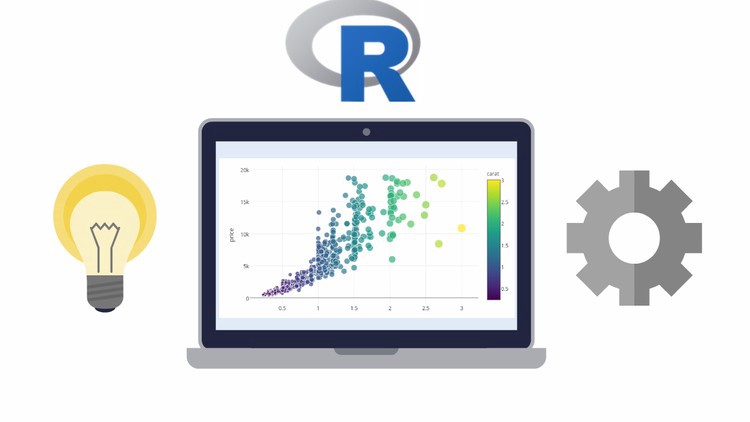
- Data Scientific discipline and Machine Learning Bootcamp with R (Jose Portilla/Udemy): Total process coverage with a tool-heavy focus (R). Less process-driven and more of a very detailed intro to R. Amazing form, though non ideal for the telescopic of this guide. Information technology, like Jose'south Python class above, can double as both intros to Python/R and intros to data science. 18 hours of content. It has a 4.6-star weighted average rating over 847 reviews. Toll varies depending on Udemy discounts, which are frequent.
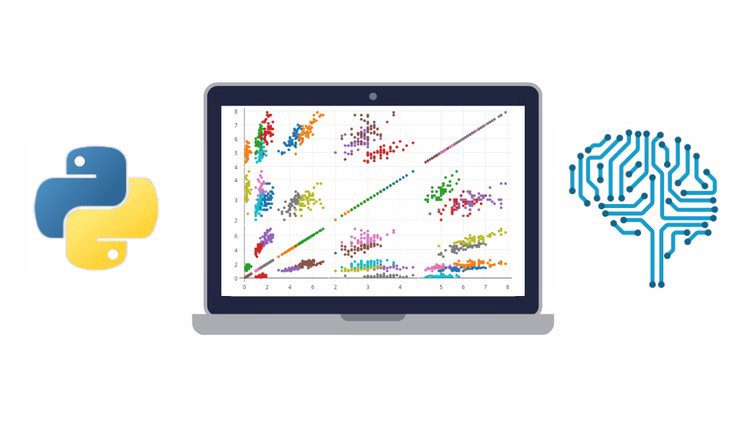
- Data Science and Machine Learning with Python — Hands On! (Frank Kane/Udemy): Fractional process coverage. Focuses on statistics and machine learning. Decent length (9 hours of content). Uses Python. It has a 4.5-star weighted average rating over 3,104 reviews. Price varies depending on Udemy discounts, which are frequent.
- Introduction to Data Scientific discipline (Information Hawk Tech/Udemy): Full process coverage, though limited depth of coverage. Quite short (three hours of content). Briefly covers both R and Python. It has a 4.4-star weighted average rating over 62 reviews. Cost varies depending on Udemy discounts, which are frequent.
- Practical Information Science: An Introduction (Syracuse Academy/Open up Educational activity by Blackboard): Total process coverage, though non evenly spread. Heavily focuses on basic statistics and R. Also applied and not plenty procedure focus for the purpose of this guide. Online course feel feels disjointed. It has a 4.33-star weighted average rating over half-dozen reviews. Free.
- Introduction To Data Science (Nina Zumel & John Mount/Udemy): Partial process coverage but, though good depth in the data training and modeling aspects. Okay length (six hours of content). Uses R. It has a 4.3-star weighted average rating over 101 reviews. Price varies depending on Udemy discounts, which are frequent.
- Practical Data Science with Python (V2 Maestros/Udemy): Full procedure coverage with adept depth of coverage for each aspect of the procedure. Decent length (viii.5 hours of content). Uses Python. Information technology has a iv.3-star weighted average rating over 92 reviews. Toll varies depending on Udemy discounts, which are frequent.
- Want to exist a Data Scientist? (V2 Maestros/Udemy): Total process coverage, though limited depth of coverage. Quite short (3 hours of content). Limited tool coverage. It has a four.3-star weighted average rating over 790 reviews. Cost varies depending on Udemy discounts, which are frequent.
- Data to Insight: an Introduction to Data Analysis (University of Auckland/FutureLearn): Breadth of coverage unclear. Claims to focus on data exploration, discovery, and visualization. Not offered on demand. 24 hours of content (three hours per calendar week over 8 weeks). Information technology has a 4-star weighted average rating over 2 reviews. Gratuitous with paid certificate available.
- Data Scientific discipline Orientation (Microsoft/edX): Partial procedure coverage (lacks modeling aspect). Uses Excel, which makes sense given it is a Microsoft-branded course. 12–24 hours of content (two-four hours per week over six weeks). It has a 3.95-star weighted average rating over 40 reviews. Free with Verified Certificate available for $25.
- Data Scientific discipline Essentials (Microsoft/edX): Full process coverage with good depth of coverage for each aspect. Covers R, Python, and Azure ML (a Microsoft car learning platform). Several 1-star reviews citing tool option (Azure ML) and the teacher'south poor delivery. eighteen–24 hours of content (three-four hours per week over six weeks). Information technology has a 3.81-star weighted average rating over 67 reviews. Free with Verified Certificate available for $49.

- Applied Data Science with R (V2 Maestros/Udemy): The R companion to V2 Maestros' Python course above. Full process coverage with good depth of coverage for each attribute of the process. Decent length (11 hours of content). Uses R. Information technology has a 3.8-star weighted average rating over 212 reviews. Cost varies depending on Udemy discounts, which are frequent.
- Intro to Data Science (Udacity): Partial process coverage, though good depth for the topics covered. Lacks the exploration aspect, though Udacity has a swell, full course on exploratory information assay (EDA). Claims to be 48 hours in length (six hours per week over eight weeks), just is shorter in my experience. Some reviews think the set-up to the advanced content is lacking. Feels disorganized. Uses Python. It has a 3.61-star weighted average rating over 18 reviews. Free.
- Introduction to Data Scientific discipline in Python (University of Michigan/Coursera): Fractional process coverage. No modeling and vizualization, though courses #two and #3 in the Applied Data Science with Python Specialization cover these aspects. Taking all iii courses would be too in depth for the purpose of this guides. Uses Python. Four weeks in length. Information technology has a 3.vi-star weighted average rating over fifteen reviews. Free and paid options available.

- Data-driven Decision Making (PwC/Coursera): Partial coverage (lacks modeling) with a business focus. Introduces many tools, including R, Python, Excel, SAS, and Tableau. Four weeks in length. It has a 3.v-star weighted average rating over ii reviews. Gratis and paid options bachelor.
- A Crash Course in Data Science (Johns Hopkins University/Coursera): An extremely brief overview of the full procedure. Also brief for the purpose of this series. Two hours in length. It has a 3.4-star weighted boilerplate rating over 19 reviews. Gratis and paid options available.
- The Information Scientist'south Toolbox (Johns Hopkins Academy/Coursera): An extremely brief overview of the full process. More of a set-up form for Johns Hopkins Academy's Data Scientific discipline Specialization. Claims to have 4–16 hours of content (i-four hours per calendar week over iv weeks), though one reviewer noted it could be completed in two hours. Information technology has a iii.22-star weighted boilerplate rating over 182 reviews. Gratis and paid options bachelor.
- Data Management and Visualization (Wesleyan University/Coursera): Fractional process coverage (lacks modeling). Four weeks in length. Good production value. Uses Python and SAS. It has a 2.67-star weighted average rating over 6 reviews. Gratis and paid options available.
The following courses had no reviews as of Jan 2017.
- CS109 Data Science (Harvard University): Full procedure coverage in slap-up depth (probably too in depth for the purpose of this series). A full 12-week undergraduate course. Course navigation is difficult since the grade is not designed for online consumption. Actual Harvard lectures are filmed. The above data science process infographic originates from this course. Uses Python. No review data. Free.
- Introduction to Data Analytics for Concern (University of Colorado Boulder/Coursera): Fractional process coverage (lacks modeling and visualization aspects) with a focus on business concern. The data science procedure is disguised every bit the "Information-Activity Value chain" in their lectures. Four weeks in length. Describes several tools, though only covers SQL in whatsoever depth. No review data. Free and paid options bachelor.
- Introduction to Information Scientific discipline (Lynda): Full process coverage, though limited depth of coverage. Quite brusk (3 hours of content). Introduces both R and Python. No review data. Price depends on Lynda subscription.
Wrapping it Upwards
This is the third of a six-piece series that covers the all-time online courses for launching yourself into the data science field. We covered programming in the showtime article and statistics and probability in the second commodity. The residue of the series volition cover other data science core competencies: information visualization and automobile learning.
If y'all desire to learn Data Scientific discipline, outset with i of these programming classes
If you want to learn Data Science, take a few of these statistics classes
The terminal piece will exist a summary of those articles, plus the best online courses for other primal topics such every bit information wrangling, databases, and fifty-fifty software engineering.
If you're looking for a complete list of Information Scientific discipline online courses, you can find them on Class Central'southward Data Science and Big Data subject area page.
If y'all enjoyed reading this, check out some of Class Central's other pieces:
Here are 250 Ivy League courses yous tin accept online right now for costless
250 MOOCs from Dark-brown, Columbia, Cornell, Dartmouth, Harvard, Penn, Princeton, and Yale.
The fifty best gratuitous online university courses according to data
When I launched Course Key back in Nov 2011, there were effectually 18 or so complimentary online courses, and almost all of…
If you have suggestions for courses I missed, permit me know in the responses!
If you lot found this helpful, click the ? so more people volition see information technology hither on Medium.
This is a condensed version of my original article published on Class Central, where I've included further grade descriptions, syllabi, and multiple reviews.
Learn to code for free. freeCodeCamp'due south open up source curriculum has helped more than twoscore,000 people go jobs every bit developers. Go started
Source: https://www.freecodecamp.org/news/i-ranked-all-the-best-data-science-intro-courses-based-on-thousands-of-data-points-db5dc7e3eb8e/
0 Response to "Professional Certificate in Data Science Harvardx Review or Coursea"
Enviar um comentário