Hinduism and the Ethics of Warfare in South Asia Review
The Pulse
The Origins of Hindu-Muslim Disharmonize in South asia
What are the historical origins of animosities betwixt Southward Asia's two largest religions?
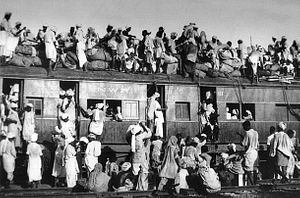
It has lately get fashionable in some circles, particularly among individuals inundated in postcolonial thought, to blame the electric current disharmonize betwixt India and Islamic republic of pakistan, and more generally, strife between Hindus and Muslims on the British, and the British Raj's colonial policies. In the words of Shashi Tharoor, an Indian parliamentarian: "The colonial project of 'split up et impera' (divide and dominion) fomented religious antagonisms to facilitate continued royal rule and reached its tragic culmination in 1947." Some academics go even further, arguing that the very religious identities of Hindus and Muslims in the subcontinent were constructed by the British, and as such, the subsequent strife between these groups was a function of this policy.
In other words, most of South asia's contemporary geopolitical and ethno-religious problems, including the Kashmir disharmonize, the division of British India into India and Pakistan, and communal strife between Hindus and Muslims, are the result of Western influence. In this view, everyone in Southern asia lived in relative harmony together before the 19th century. Often, British policies such as the 1909 decision to give Indian Muslims a separate electorate from Hindus in local elections, every bit well equally the British role in Bharat's 1947 division, are cited as proof of this policy to sow conflict between Indians. Notwithstanding, on the other paw, the work of historians like Ajay Verghese, an assistant professor of political science at the Academy of California, accept demonstrated that areas in India formerly governed by princely states have more communal riots than the provinces in India ruled directly by the Raj.
The thought of communal harmony and unity flies in the confront of historical prove and native literature, equally well as Due south Asians' own memories and interpretations of their ain identities and histories. The British Raj was not some totalitarian regime that had the ability, fifty-fifty if it so desired, to create conflict and entire religious categories from nada in S Asia. Information technology was a highly complex entity that was the upshot of the interplay between British interests, local groups, and rulers ("princes"), and as the 19th century wore on, organized movements of the middle-class Indian professionals. As the blogger and geneticist Razib Khan, who focuses heavily on Southern asia, noted, "The reason I take no patience for the constant indictments of the British is that Due south Asian elites had their ain agency, and their own history, long earlier the British became the major ability in the subcontinent, and retained that agency afterwards." (For a total treatment of Khan's analysis of the thousand-year history of Hindu-Muslim relations in Southern asia, see his post here.)
Bharat'due south partition and the disharmonize over Kashmir, a Muslim-majority princely state ruled by a Hindu dynasty, were driven past local interests and philosophy, including the two-nation theory, which held that the Muslims of British India should be granted their own country, Pakistan. According to Muhammad Ali Jinnah, the founder of Pakistan:
Hindus and Muslims vest to two different religious philosophies, social customs and literary traditions. They neither intermarry nor eat together, and indeed they belong to ii unlike civilizations which are based mainly on conflicting ideas and conceptions.
This view of Hindus and Muslims belonging to two different civilizations is problematic for many mod thinkers, who seek in the British Raj an explanation for the subcontinent'due south divides. Was this divide — the different social customs and philosophies that Jinnah referred to — the result of a colonial plot? Or is there a deeper civilizational divide?
There is no doubt that often aspects of Hindu and Islamic, particularly Western farsi and Turkic, cultures influenced each other. As it is often pointed out, "at the village level… Hindus and Muslims shared a broad spectrum of customs and beliefs, at times even jointly worshiping the same saint or holy spot."
Cynthia Talbot, a historian who focuses on pre-colonial India, argues that while "no one would deny that modernization has led to the sharper articulation of identities encompassing wide communities… mod identities do not bound fully fashioned out of nowhere. They commonly employ the myths and symbols of earlier forms of identity that may exist less clearly formulated and more than restricted in circulation but are nonetheless incipient cores of ethnicity." In her volume India Earlier Europe, she writes, "Although the religious beliefs and practices of India were never systematized by a central institution or spiritual potency, the circulation of Sanskrit and Brahmins throughout the subcontinent did produce some semblance of a unified religious culture at the elite level past 1000 CE." Other scholars argue that the inflow and conquest of Muslim "others" acquired the various related native traditions to reify equally Hinduism, a process that began long before the British arrived. Thus, there was an ethnic self-sensation of a native tradition distinct from the newly introduced Islam, though the term Hinduism was non yet fully in place.
On the other hand, Islam, similar Christianity, was more self-aware of its distinct and often exclusionary identity from its onset. Local spiritual practices even so, almost Muslim elites in Southern asia were strongly aware of their unique cultural identity — with significant influence from the Middle East — separate from the more than subcontinent-centric Hindus, even if they were not particularly religious, and fifty-fifty if they got along well with Hindus. The procedure of modernization, regardless of British involvement, expanded literacy, urbanization, and led to the "move of ideology from the elite to the masses," equally Khan argues. Moreover, "confessionalization in some sense is part of the process of modernity and evolution, along with the expansion of the literate course."
Therefore, the partition between Hindus and Muslims in South Asia is nobody'due south error or plot, actually, but a natural event of the emergence of a mass political culture. The reason for this divide is because Hindus and Muslims in the subcontinent naturally have utilized different points of reference when drawing upon history to articulate their sociopolitical goals and build their modern identities. Such thinking is non rare. In 18th and 19th century Europe, thinkers looked back to different periods of European history for inspiration. While the Enlightenment was more neoclassical in nature, and drew upon Europe'southward Greco-Roman heritage, the subsequent Romantic movement arcadian the medieval period, and as such, was very unlike in its philosophy. Unlike in Europe, in Due south Asia, the thinkers and elites who looked dorsum to their region'southward respective classical and medieval periods were not the same individuals, and ofttimes belonged to different religious groups.
No thing how much syncretism and fluidity there may have been, it would have been difficult for India'south two sets of elites — the Hindu brahmin-kshatriya combine on one mitt, and the Perso-Turkic Muslims — to have agreed upon which aspects of Bharat's history to depict upon to build modern identities. Information technology is true that Akbar and several other Mughal rulers patronized brahmins and sages, while Muslims served in aristocracy roles in the armies of Hindu states like Vijayanagara, Mysore, and the Maratha Empire. But the ultimate cultural orientations of Hindu and Muslims states were different, and invariably Hindu and Muslim rulers in modern India would carve toward their own sectarian preferences.
The instance of the state of Mysore is instructive in this sense: while it was ruled by the Hindu Wodeyar dynasty, the court language and religion were Kannada and Hinduism, merely when the state came under the dominion of Muslims, Hyder Ali, and his son, Tipu Sultan, Farsi language and literature and Islam were given ladylike prominence. For this reason, the 2-nation theory is not an thought that came out of nowhere. The Muslims of Southern asia look to the glorious days of the Mughal Empire, and the flowery literature of Persian and Urdu, written in the Arabic script, for symbolism and inspiration, while Hindus look to the Mauryan and Gupta Empires, their aboriginal epics, and the Hindu golden age. When much of n Bharat came nether the rule of Muslim dynasties, naturally state funds and support went more than toward mosques and centers of Islamic learning than to Hindu temples and philosophical institutions. This lack of state patronage is thought to have changed the nature of Hinduism past favoring the aspects of it that were more than family and village oriented.
One solution would have been for the modern Indian state, unpartitioned, to have had two sets of symbols and mottoes, for Hindus and Muslims (though what of the Christians, Sikhs, Jains, Buddhists, Zoroastrians, and other religious groups?). Only mod nation building is virtually articulating a unifying set of national principles, whether ethnic, cultural, or civic. It is the weather condition of modernity and the nation-state that let and spur India's ii largest groups, Hindus and Muslims, to articulate different visions of the future, which can exist seen through the different articulations of identity and history in India and Pakistan, the latter of which is the state-level manifestation of the intellectual consciousness of South Asian Muslims, despite the existence of Bangladesh, and despite in that location being hundreds of millions of Muslims in Bharat.
Even when Republic of india was founded as a secular land after independence, it still draw upon much of the symbolism of ancient, pre-Islamic India, from the bicycle in the middle of its flag, a symbol taken from the Mauryan Emperor Ashoka, to its national motto, taken from the Hindu Upanishads, and written out in the native Devanagari script, सत्यमेव जयते satyameva jayate ("truth alone triumphs"). Information technology is not unnatural that India drew upon its aboriginal heritage and the Sanskrit language in the way many Western countries draw upon Latin and some Christian symbolism. But the Muslim elites of South asia had something very different in mind. For case, Pakistan'due south national motto features three words all derived from and written in the Arabic script, ایمان، اتحاد، نظم i human, ittihad, nazm ("faith, unity, subject field"). Conspicuously these are two visions that would take been hard to reconcile in the context of the development of mod identities and nation-states.
As the author and Nobel laureate 5.S. Naipaul wrote in India: A Million Mutinies Now, it was perhaps but a matter of time before modern Republic of india, with its Hindu bulk, looked back to those ancient roots to rebrand itself for modernity:
What I hadn't understood in 1962, or had taken too much for granted, was the extent to which the state had been remade; and even the extent to which India had been restored to itself, later on its own equivalent of the Dark Ages – after the Muslim invasions and the detailed, repeated vandalizing of the North, the shifting empires, the wars, the 18th-century anarchy. The twentieth-century restoration of India to itself had taken time; it could even seem like a kind of luck. Information technology had taken much to create a Bengali reformer like Ram Mohun Roy (born in 1772); it had taken much more to create Gandhi (born in 1869). The British peace after the 1857 Mutiny can exist seen as a kind of luck. It was a time of intellectual recruitment. India was set on the mode of a new kind of intellectual life; information technology was given new ideas most its history and civilization.
Of form none of this is to contend that Hindus and Muslims can not, and should not, become along well with each other and synthesize their cultures. They ought to, and moreover, South Asian states should go on to extend full political liberties to all people regardless of religion, ethnicity, linguistic communication, or nation. Simply in the process of drawing upon ancient histories for creating modernistic national national identities, it was inevitable, perhaps, that in that location would be some tension betwixt the two differing visions articulated by different elites and communities in the subcontinent, because they derive from two unlike social and religious ideologies, and have unlike visions of the modernistic state. Thus, Hindu-Muslim conflict in South Asia derives from no one particular factor, only is a office of the friction betwixt different communities with dissimilar modernizing visions. Such a phenomenon is hardly unique to South asia, and can be found throughout the world, wherever in that location are carve up peoples and nations living together in shut proximity.
Source: https://thediplomat.com/2019/03/the-origins-of-hindu-muslim-conflict-in-south-asia/
0 Response to "Hinduism and the Ethics of Warfare in South Asia Review"
Enviar um comentário