Is the Military Still Agains Tgays
The United states military formerly excluded gay men, bisexuals, and lesbians from service. In 1993, the United States Congress passed, and President Bill Clinton signed a law instituting the policy commonly referred to equally "Don't inquire, don't tell" (DADT) which allowed gay, lesbian, and bisexual people to serve as long as they did not reveal their sexual orientation. Although in that location were isolated instances in which service personnel were met with limited success through lawsuits, efforts to cease the ban on openly gay, lesbian, and bisexual people serving either legislatively, or through the courts initially proved unsuccessful.
In 2010, two federal courts ruled the ban on openly gay, lesbian, and bisexual service personnel unconstitutional, and on July vi, 2011, a federal appeals court suspended the DADT policy. In December 2010, the House and Senate passed and President Barack Obama signed the Don't Inquire, Don't Tell Repeal Act of 2010, and under its provisions, restrictions on service by gay, lesbian, and bisexual personnel ended as of September xx, 2011.
According to a RAND Corporation written report, a 2015 survey of over sixteen,000 service members institute that 5.8% of the respondents identified every bit being lesbian, gay or bisexual.[1] When separated by gender, 1.9% of males identified as gay and two.0% as bisexual.[one] While seven.0% of females identified every bit lesbian and 9.1% equally bisexual.[1]
History [edit]
Early on years [edit]
To train the new American Army in the latest military drills and tactics, General George Washington brought in Friedrich Wilhelm von Steuben (1730–94), who had been an officeholder on the German language Full general staff. Von Steuben escaped Germany where he was threatened with prosecution for homosexuality. He joined Washington'due south army at Valley Forge in February 1778 accompanied by 2 immature aides. Steuben became an American general, and a senior counselor to Washington. Despite rumors about his parties, there never was an investigation of Steuben and he received a Congressional pension subsequently the war.[two] [3]
The first evidence of antipathy to homosexuals serving in the United States armed forces dates from March eleven, 1778, when Lieutenant Frederick Gotthold Enslin was drummed out of the Continental Army following his conviction at courtroom-martial on charges of sodomy and perjury.[four]
1910s–1940s [edit]
The U.S. armed services discharged soldiers for homosexual acts throughout the eighteenth and nineteenth century even in the absence of any explicit prohibition of sodomy. The Articles of War of the United States of 1916, implemented on March ane, 1917, included Article 93 stating that whatever person subject field to military machine law who committed "set on with intent to commit sodomy" shall be punished as a court-martial may straight.[5] That was modified on June 4, 1920, to make the human activity of sodomy itself a crime.[5] The change went into effect on February 4, 1921.[6] It was the kickoff limited prohibition of homosexuality or homosexual conduct in the armed forces of the United States.[7]
The several branches of the U.Due south. lacked a unified policy on service by homosexuals for about of their history. Before 1949, each tended to accuse personnel defenseless engaging in homosexual deport with sodomy, court-martial them, and effect them a dishonorable belch. In 1940, psychiatrists Harry Stack Sullivan and Winfred Overholser formulated guidelines for psychiatric screening for military inductees. Both believed homosexuals should not be inducted, and neither proposed excluding all homosexuals from military machine service. Despite their recommendations, other psychiatrists and war machine officials made homosexuality a key component of the screening apparatus they recommended.[8] The United States Army Surgeon General's office issued a circular in 1941 that for the first time classified "homosexual proclivities" every bit disqualifying inductees from armed services service. The United States Navy and the Selective Service adopted like exclusionary policies.[ix] The Women's Army Corps adopted a similar policy in 1944.[10] The Women'south Army Corps instituted harsh screening policies for recruits, ofttimes based on physical appearance and gender conformity, in society to exclude lesbians from service. WAC policies also condoned heterosexual relationships with servicemen in order to discourage homosexual carry.[11]
With the mass mobilization and deployment of troops for operations in World War II, it became impractical to convene court-martial boards for homosexual bear offenses. Commanders instead issued blueish discharges – a course of administrative military discharge – to homosexual personnel. All the same, bluish discharge holders faced difficulties in civilian life because the bluish discharge carried with it a negative association. The Veterans Assistants denied blue-discharge veterans the benefits of the G.I. Nib as a full general policy.[12] In 1944, a policy directive ordered that homosexuals were to be committed to military machine hospitals, examined past psychiatrists and discharged nether Regulation 615-360, section 8.[13]
For example, staff sergeant Allen Irvin Bernstein, who was arrested in January 1944 by military police after a failed pickup attempt with another soldier, was bars in a psychiatric ward at Camp Lee, Virginia, and discharged within a month. He subsequently appealed the discharge determination, attaching a copy of his 140-folio defense of homosexuality, Millions of Queers (Our Homo America), which, notwithstanding, was ignored and remained forgotten and unpublished until rediscovered in 2010 past a researcher in the National Library of Medicine. Denied all veterans benefits, Bernstein continued to refile appeals with the Army until, 37 years later, the Army accepted his appeal and retroactively converted his blue discharge to an honorable belch in 1981.[14]
Blueish discharges were discontinued in May 1947 and replaced with ii new headings, "full general" and "undesirable".[xv] A general discharge was considered to be under honorable conditions though distinct from an "honorable discharge." An undesirable discharge was under atmospheric condition other than honorable, yet distinct from a "dishonorable discharge".[16] The Army likewise changed its regulations to ensure that homosexuals would not qualify for general discharges.[17] Under this system, a servicemember found to be homosexual but who had not committed any homosexual acts while in service received an undesirable discharge. Those institute guilty of engaging in homosexual conduct were dishonorably discharged.[xviii]
In 1945, four honorably discharged gay veterans formed the Veterans Benevolent Association, the first such system.[nineteen] It was primarily social in nature and its membership peaked at 100. The group disbanded in 1954,[20] and several of its members after formed the New York chapter of homophile advocacy group I, Inc.[21]
Standard policy, 1949–1993 [edit]
In October 1949, the newly consolidated Department of Defense standardized anti-homosexual regulations across all branches of the armed services: "Homosexual personnel, irrespective of sex, should non exist permitted to serve in any branch of the Armed Forces in any chapters, and prompt separation of known homosexuals from the Military is mandatory."[22]
President Harry Due south. Truman signed legislation on May 6, 1950, creating the Uniform Code of Armed forces Justice, which became constructive on May 31, 1951. It established a single justice system for the armed forces.[23] Its Article 125 forbids sodomy among all armed forces personnel, defining an offender equally "any person bailiwick to this affiliate who engages in unnatural carnal copulation with some other person of the aforementioned or opposite sexual practice or with an animal is guilty of sodomy. Penetration, however slight, is sufficient to complete the offence."[5]
The success of the military in pre-screening cocky-identified gay and bisexual people from the 1940s through 1981 remains in dispute; during the Vietnam War, some men pretended to exist gay in lodge to avoid the typhoon.[24] Withal, a significant number of gay and bisexual men and women did manage to laissez passer through the screening process and serve in the military, some with special distinction.
For example, in the 1950s, the Navy medical doctor Tom Dooley received national fame for his anti-Communist and humanitarian efforts in Vietnam. He was forced to resign in March 1956 when found to have participated in homosexual activities.[25] The Navy conducted the first official report on sexual orientation and the Navy regulations and rules. In 1957, the Crittenden Study found that gay-identified people were no more likely to be a security risk than heterosexual-identified people, just nevertheless recommended that homosexuals be excluded from service because "Homosexuality is wrong, it is evil, and it is to be branded as such."[26]
San Francisco political leader and gay rights campaigner Harvey Milk served in the Us Navy during the Korean War. He served aboard the submarine rescue ship USS Kittiwake (ASR-13) every bit a diving officer, later transferring to Naval Station, San Diego to serve equally a diving instructor. In 1955, he was discharged from the Navy at the rank of lieutenant, inferior grade, though whether his homosexuality was an result in his discharge is doubted past researchers.[note 1]
By the 1970s, a gay servicemember who had not committed any homosexual acts while in service generally received a general discharge, while those found to have engaged in homosexual conduct more than often received undesirable discharges.[27] Gay servicemembers received a disproportionate per centum of undesirable discharges issued.[28]
During the 1970s, beginning with Leonard Matlovich, who was featured on the comprehend of Fourth dimension magazine in 1975 (making him the offset named openly gay person to announced on the encompass of a U.S. newsmagazine[29] [xxx]), several high-contour court challenges to the war machine's regulations on homosexuality occurred, with little success, and when such successes did occur it was when the plaintiff had been open most his homosexuality from the beginning or due to the existence of the "queen for a twenty-four hour period" rule, which stated that if a service-fellow member was caught having sexual activity with a person of the same gender they could avoid being discharged if the "member did non have a propensity of intent to engage in homosexual acts."[31]
In 1981, the Department of Defence force issued a new regulation on homosexuality that was designed to ensure withstanding a courtroom challenge by developing uniform and conspicuously divers regulations and justifications that made homosexual status, whether cocky-applied or past the military, and conduct grounds for discharge (DOD Directive 1332.14 (Enlisted Administrative Separations), January 1981):
- Homosexuality is incompatible with military service. The presence in the military environment of persons who engage in homosexual behave or who, by their statements, demonstrate a propensity to engage in homosexual bear, seriously impairs the accomplishment of the military mission. The presence of such members adversely affects the ability of the armed forces to maintain subject area, proficient order, and morale; to foster mutual trust and confidence amidst service members; to ensure the integrity of the system of rank and control; to facilitate assignment and worldwide deployment of service members who frequently must alive and piece of work in close conditions affording minimal privacy; to recruit and retain members of the war machine; to maintain the public acceptability of armed forces service; and to prevent breaches of security.
The directive justified the policy and removed the "queen for a twenty-four hours" rule that had prompted some courts to dominion against the war machine. However, the intent of the policy had also been to care for homosexuality as beingness akin to a disability discharge and thus ensure that anyone found engaging in homosexual activity and/or identifying every bit gay, would be separated with an honorable belch. The DOD policy has since withstood most courtroom challenges, although the United States Supreme Courtroom has refused to weigh in on the constitutionality of the policy, preferring to let lower courts and the United States Congress to settle the matter.
In the 1980s, many of the Autonomous Political party presidential candidates expressed an interest in irresolute the regulations apropos homosexuality in the armed forces, and, as American social mores inverse, public opinion began to express more sympathy with gay people in armed forces, at least to the extent that investigations into a serviceman or -woman'due south sexual behaviour and/or orientation were seen equally a witch-chase. "Gays in the military" became a political issue during the 1992 Presidential campaign, when Clinton, the Autonomous candidate, promised to lift the armed forces's ban on homosexual and bisexual people.
In 1992, the United States General Bookkeeping Role published a written report entitled Defense Force Management: DOD'south Policy on Homosexuality, that outlined the DOD policy on homosexuality and the reasons for it. The study also included excerpts from a previously unpublished 1988 Defense Personnel Security Inquiry and Education Centre written report on homosexuality that made similar conclusions every bit the 1957 Crittenden Report.[32]
Some LGBT military machine personnel sought to overturn the military'southward ban on service by homosexuals. Among the earliest were Leonard Matlovich, who fought to remain in the Air Force afterwards coming out in 1975,[33] and Perry Watkins, who was drafted in 1967 despite disclosing his homosexuality on his consecration papers.[34] District Court judge Gerhard Gesell ordered Matlovich'southward reinstatement in 1980.[35] Rather than return Matlovich to duty, the Air Force offered him a greenbacks settlement of $160,000, which Matlovich accustomed.[36] The Army tried to discharge Watkins several times, until the The states Courtroom of Appeals for the 9th Circuit ordered his reinstatement in 1989 and the Usa Supreme Court refused to hear the example. The appellate courtroom, yet, did not rule the military policy unconstitutional in Watkins's case. Rather, it decided that elementary equity mandated that the Army could not discharge Watkins for homosexuality when it knew of his sexual orientation all along.[37] Other high-contour discharges included those of Vernon Berg, Three, Keith Meinhold, and Tracy Thorne from the Navy; Joseph Steffan from the Naval Academy; Margarethe Cammermeyer from the Washington National Guard; and Miriam Ben-Shalom from the Regular army Reserve.
At the height of the push to rescind the ban before DADT, Miriam Ben-Shalom joined with other discharged personnel to grade the Gay, Lesbian & Bisexual Veterans of America.
Don't ask, don't tell, 1993–2011 [edit]
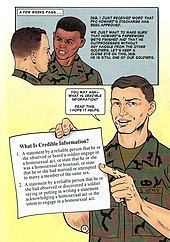
Paradigm from a U.South. Regular army training manual, 2001, regarding homosexuality
Don't enquire, don't tell (DADT) is the common term for the policy restricting the United States military machine from efforts to discover or reveal closeted gay, lesbian, and bisexual service members or applicants, while disallowment those that are openly gay, lesbian, or bisexual from military service.
Following the implementation of DADT, the Servicemembers Legal Defense Network was formed to protect the rights of active duty personnel. Other organizations include Servicemembers United which formed in 2005 by veterans of the wars in Iraq and Afghanistan,[38] and groups associated with West Betoken (Knights Out) and the Naval Academy (USNA Out).
Service members discharged nether DADT connected to seek redress through the courts without success. Courts often cited the Supreme Courtroom'southward 1986 decision in Bowers v. Hardwick, which upheld the constitutionality of state sodomy laws. Later on the Supreme Court reversed Bowers in Lawrence v. Texas (2003), the Courtroom of Appeals for the Armed Forces ruled that the Lawrence v. Texas decision applies to Commodity 125 of the Uniform Lawmaking of Armed services Justice, which banned all acts of sodomy. In both United States 5. Stirewalt and United States v. Marcum, the court found Article 125 constitutional, but ruled that the "deport falls within the liberty interest identified by the Supreme Court,"[39] but as well said that despite the awarding of Lawrence to the military, Article 125 could still be upheld in cases where at that place are "factors unique to the armed services surroundings" that would place the deport "exterior whatsoever protected liberty interest recognized in Lawrence",[40] such as fraternization, public sexual behavior, or anything that would adversely affect good lodge and discipline. Convictions for consensual sodomy accept been overturned in military courts under the Lawrence in The states v. Meno [41] and United States v. Bullock.[42] In the course of reviewing the end of DADT, the Department of Defense's Comprehensive Review Working Group recommended repealing or amending Commodity 125 to eliminate any ban on consensual sodomy betwixt adults.[43]
Major legal challenges to the DADT policy include Witt v. Department of the Air Forcefulness and Log Motel Republicans v. United States. The commencement ended in a negotiated settlement, merely only after the lesbian plaintiff whom the Air Strength tried to discharge won retirement with full benefits in 2011 as DADT neared its end. In the 2d, Federal Approximate Virginia A. Phillips ordered the armed services on Oct 12, 2010, to suspend and discontinue whatsoever investigation or belch, separation, or other proceeding that began under DADT.[44] A series of appeals and stays of her ordered followed in the fall of 2010 only as Congressional attempts to repeal DADT took shape.
An attempt to repeal DADT began in May 2010 when the House approved an amendment to the 2011 National Defence force Dominance Act. It failed in September, when Sen. John McCain led a successful filibuster confronting it.[45] In Dec 2010, after a second Senate delay, Senators Joe Lieberman and Susan Collins introduced the Don't Enquire, Don't Tell Repeal Act of 2010. It passed the Business firm of Representatives on Dec 15.[46] [47] and the Senate on Dec 18 by a vote of 65-31.[48] President Barack Obama signed the bill on December 22.[49]
On December 29, 2010, the Section of Justice asked the 9th Excursion Court of Appeals to append proceedings in the Log Cabin instance. Instead, on July 6, 2011, that courtroom, citing progress made by military officials in preparing for an end to DADT, ordered the government to cease enforcement of DADT while dismantling the policy.[50]
Repeal was non firsthand. The Department of Defense first reviewed its policies and guidelines and drafted implementation regulations. And so the President, the Secretary of Defence force and the Chairman of the Joint Chiefs of Staff certified that new regulations had been drafted and that the new regulations would non damage military cohesion and readiness. That certification triggered a lx-day waiting period at the stop of which, on September 20, 2011, DADT expired.[51]
Service academies [edit]
A research report that appeared in the journal Armed forces & Guild at the end of 2011 said that military academy cadets opposed allowing homosexuals to serve openly in greater percentages than participants in ROTC did, and that both groups opposed such service to a greater degree than their civilian counterparts.[52] Some news outlets viewed this every bit a negative reaction to the repeal of DADT earlier in the year,[53] but the authors of the study said information technology drew on survey data nerveless betwixt 2002 and 2007 and believed their inquiry provided no data about opinions following the end of DADT. They wrote that the strong caste of anti-gay sentiment found among entering cadets declined somewhat during their fourth dimension at the service academies: "Surprisingly, military culture appears to have made cadets more tolerant of gays and lesbians, not less."[54]
After DADT [edit]

Barack Obama signing the repeal of 'Don't Enquire, Don't Tell', a policy that forbade gay and lesbian people from openly serving in the U.s.a. armed services.
Benefits [edit]
Despite the end of DADT on September twenty, 2011, the same-sexual activity spouses of gay and lesbian service members were not treated on a par with the different-sex spouses of war machine service members because of restrictions imposed by Section three of the Defence force of Marriage Act (DOMA) and certain federal statutes that contain definitions of marriage that exclude same-sex couples. Same-sex spouses are denied death benefits, identification cards, base of operations access, access to repatriation ceremonies, and other entitlements.[55]
In Dec 2012, the Association of Bragg Officers Spouses (ABOS) denied membership to Ashley Broadway, the female spouse of a female Ground forces officer.[56] During the weeks of press coverage that ensued, Fort Bragg's commander said he lacked authorisation over the individual organization while the U.S. Marines announced that clubs conducting business on base of operations must admit aforementioned-sex spouses.[57] ABOS offered Broadway a "special guest membership", which she declined.[58] On January 26, Military Spouse mag named Broadway Fort Bragg's 2013 "Military Spouse of the Twelvemonth".[59] That same twenty-four hour period, ABOS invited Broadway to bring together and announced that its membership was open to "any Spouse of an agile duty commissioned or warrant Officer with a valid marriage certificate from whatsoever land or district in the United states of america".[60]
On February 11, 2013, Secretary of Defense Leon Panetta announced the Department's extension of certain war machine "boosted benefits" to same-sexual practice spouses which are non explicitly prohibited under the Defense of Marriage Act, in addition to "member-designated benefits" which were already available to aforementioned-sex spouses.[61] [62] In June 2013, the Pentagon announced plans to begin issuing identification cards to the same-sex partners of servicemembers, which will permit them to access education, survivor, commissary, travel, counseling and transportation benefits, only non wellness care and housing allowances.[63]
Discharge pay [edit]
The American Civil Liberties Wedlock (ACLU) brought adjust in 2010 on behalf of servicemembers discharged for homosexuality who received only half the standard separation pay upon discharge. All were discharged under the DADT policy, but the ACLU said that the practice ante-dated the adoption of DADT.[64] On January vii, 2013, the ACLU reached a settlement with the federal regime in Collins 5. United States that provided for the payment of full separation pay to servicemembers discharged under "Don't ask, don't tell" since November x, 2004.[65] Some 181 were expected to receive nigh $13,000 each.[66]
Veterans associations [edit]
The American Military Partner Clan (AMPA) was formed in 2009 to enable the LGBT partners of servicemembers and veterans to provide support in areas where the war machine fails to and to advocate on behalf of equal treatment of those in aforementioned-sex activity relationships.[67]
Less than honorable discharges [edit]
Following the finish of DADT, approximately 114,000 servicemembers who had been separated from war machine service since WW 2 under the categories "other than honorable belch", "general belch", or "dishonorable discharge" became eligible to have their discharges amended. Those without an honorable belch are often excluded from veterans benefits similar health intendance and tuition assistance, and the lack of an honorable discharge tin create a hurdle to employment in the civilian sector as well. The Military machine established procedures for processing such requests through the Military Section Board for Correction of Military/Naval Records or the Military Department'southward Discharge Review Board.[68] In June 2013, later on advocates for gay and lesbian veterans complained about the procedure, Representatives Marker Pocan (D-Wisconsin) and Charles Rangel (D-New York) introduced the Restore Honor to Service Members Act in the House of Representatives to codify the process and reduce inconsistencies. Pocan said the legislation represented the same policies equally those currently in place, merely was needed because "without having it in law, it could alter at some date in the future with a different administration."[69] The American Bar Association endorsed the legislation on Nov 21, 2013.[70] On January 30, 2014, Senator Brian Schatz (D-Hawaii) introduced the same legislation in the Senate.[71]
Later Windsor [edit]
On June 26, 2013, the Supreme Court held in Us v. Windsor that the statute nether which the U.S. military was withholding benefits from servicemembers in same-sex marriages, Section three of the Defense of Marriage Act, was unconstitutional. Secretarial assistant of Defense Chuck Hagel stated: "The Department of Defence force welcomes the Supreme Court's conclusion [and] volition immediately begin the process of implementing the Supreme Court's conclusion in consultation with the Department of Justice and other executive branch agencies. The Section of Defence force intends to make the same benefits available to all military spouses—regardless of sexual orientation—as soon as possible."[72]
On August 14, 2013, the Department of Defense (DoD) announced that it would provide spousal and family benefits to servicemembers in same-sex marriages on the same terms as it does to those in different-sex marriages. The benefits, which include wellness care coverage, housing allowances, military ID cards, and survivor benefits, tin can be claimed retroactive to June 26, the 24-hour interval of the Windsor determination. A aforementioned-sexual practice marriage must be documented by a marriage certificate that establishes that the union was valid where it was celebrated. The DoD also appear that servicemembers who need to travel to a jurisdiction that allows them to ally volition exist afforded upward to seven days exit to practice so, upward to 10 days if they are stationed exterior the U.South. Secretary of Defense Chuck Hagel said: "This will provide accelerated access to the full range of benefits offered to married military couples throughout the department, and help level the playing field between opposite-sex and aforementioned-sexual practice couples seeking to exist married". The DoD set September 3 equally its target date for implementation.[73] [74] the servicemember'due south commander determines the amount of go out to be granted based on the servicemember'south unit responsibilities and specific situation. Peter Sprigg of the Family Enquiry Council, a longtime opponent of the end of "don't ask, don't tell", wrote that "It could well be argued that the new policy actively discriminates confronting opposite-sexual practice couples, who receive no special leave for their weddings". DoD officials said the leave was for travel and cited Texas or Republic of korea every bit locations that pose issues for same-sex couples seeking to ally.[75] The policy does non utilize to those in aforementioned-sex legal relationships other than marriage, such as civil unions and domestic partnerships.
The Veterans Administration has cited other federal statutes that define "spouse" and 'surviving spouse' The status of benefits for veterans in aforementioned-sex relationships was the bailiwick of ongoing lawsuits.
Discrimination [edit]
In 2015, Defense Secretary Ash Carter added sexual orientation to the listing of nondiscrimination protections under the military's equal opportunity program.[76] Yet, LGBT service members and veterans proceed to face discrimination in the Veterans Wellness Assistants. Often healthcare systems deny adequate services and visitation rights to aforementioned-sexual practice couples.[77] HIV-positive service members overseas frequently had their possessions thrown overboard when their fellow comrades institute out they tested positive.[78]
Lawsuits and veterans benefits [edit]
Several lawsuits on behalf of aforementioned-sex armed services spouses had challenged the constitutionality of DOMA and statutes that define "spouse" and "surviving spouse" as "a person of the reverse sexual activity" when determining eligibility for veterans benefits.
On October 27, 2011, the Servicemembers Legal Defense Network (SLDN) had brought suit in federal court in Massachusetts on behalf of several armed services servicemembers and veterans in same-sexual practice marriages. The benefits at event in that case, McLaughlin v. Panetta, included medical and dental benefits, basic housing and transportation allowances, family unit separation benefits, visitation rights in military hospitals, and survivor do good plans.[79] On June 27, the federal estimate hearing the example asked the parties to explain by July eighteen why the logic that found Windsor unconstitutional did not apply to that definition as well.[lxxx] On July 18, the Bipartisan Legal Advisory Group BLAG, which had dedicated DOMA and the restrictive definitions of marriage acknowledged that "[t]he Supreme Court recently resolved the issue of DOMA Section three's constitutionality" simply took no position on the other statutes except to say that the constitutionality of those definitions "remains open".[81] The Section of Justice told the court that it would not defend those statutes. BLAG asked to withdraw from a similar lawsuit in federal courtroom in California, Cooper-Harris v. United states of america, on July 22.[82] On August 29, Judge Consuelo Marshall ruled that the provisions of Title 38 of the U.South. Code that ascertain spouse so as to exclude those in aforementioned-sex marriages are unconstitutional.[83]
A similar instance involving only veterans benefits, Cardona five. Shinseki, is awaiting resolution in the Courtroom of Appeals for Veterans Claims, after being suspended while awaiting the resolution of Windsor. On July nineteen, 2013, Veterans Assistants (VA) Secretary Eric Shinseki noted in a letter of the alphabet about the case that the statutory definitions of "spouse" and "surviving spouse" had all the same to be invalidated by a courtroom. The VA is waiting for guidance from the Justice Department on how Windsor applies to those statutes.[84] Even if that statutory limitation is invalidated, the VA'southward rules for establishing the validity of a marriage may restrict benefits to same-sex married couples residing in a jurisdiction that recognizes their spousal relationship or who resided in the jurisdiction where they married.[85] The Respect for Marriage Act sponsored by Senator Dianne Feinstein and Representative Jerrold Nadler eliminates the question of residence by establishing a rule for federal purposes that a marriage is valid if it was valid where celebrated. They reintroduced the legislation the day Windsor was decided.[86]
On September iv, Attorney Full general Eric Holder, as required by police, notified Speaker of the House John Boehner that the Obama administration had determined that it should not enforce the federal statutes that define spouse in a way that excludes aforementioned-sexual activity spouses. He cited Windsor and the decision in Cooper-Harris the previous week as well as BLAG's withdrawal from litigation challenging the statutes in question. Advocates for same-sex spouses of veterans welcomed the announcement, only noted that the question of the rights of such spouses remained uncertain if they live in states that exercise not recognize their marriage.[87]
On September 13, 2013, VA home loan benefits were extended to include service members in same-sexual practice marriages.[88]
In June 2014, the Section of Veterans Affairs (VA) appear that it would but provide benefits to the same-sex spouses of veterans who either (i) married in the state in which they resided or (2) live in a country that recognizes their marriage when they apply for benefits. On August 18, the American Armed services Partner Association filed an entreatment in the U.Southward. Court of Appeals for the Federal Circuit challenging the VA's interpretation of federal police force. Their brief cited Windsor and many federal courtroom decisions since Windsor that have held denial of marriage rights to same-sex couples unconstitutional. It said the VA's policy ruling "imports into federal police unconstitutional state definitions of marital condition."[89] [xc]
National Guard [edit]
In several states that did non recognize same-sex marriages–notably Oklahoma, Georgia, Louisiana, Mississippi, and Texas–National Guard officials initially refused to comply with Department of Defense directives to permit the same-sex spouses National Baby-sit members in their states to enroll in federal benefit programs, instead requiring such members to travel to federal facilities to practice so.[91] Guard officials in Oklahoma enrolled some same-sex couples until September 5, 2013, when Governor Mary Fallin ordered an finish to the practice.[92] Defense force Secretary Hagel on October 31 said he would insist on compliance.[93]
On November 6, Fallin announced that Oklahoma baby-sit members could have benefits requests for same-sex spouses processed at federal facilities.[94] On Nov xx, afterward DoD officials objected to that programme, Fallin ordered that all married couples would be required to have benefits requests candy at those facilities.[95] On November 26, Texas agreed to conform with DoD policy stating that state workers would be considered federal workers while enrolling same-sex couples for benefits.[96] Louisiana adopted a policy like that of Texas on Dec 3,[97] equally did Georgia,[98] and Mississippi the same week.[99] On December 12, Secretary of Defence force Hagel appear that all state national guard units were in compliance, though iii of them–Oklahoma, Florida and South Carolina–allowed all baby-sit members to employ for ID cards and benefits only at federal facilities. Some other states chose to place their state employees on federal status for the sake of processing such applications.[99]
Sodomy police force [edit]
The National Defense force Authorization Act for Fiscal Year 2014 enacted in Dec 2013 repealed the ban on consensual sodomy constitute in Article 125 of the Uniform Lawmaking of Military machine Justice.[100]
Obergefell [edit]
The 2015 U.S. Supreme Courtroom decision in Obergefell v. Hodges legalized aforementioned-sex activity marriage in all 50 states, providing a means for same-sexual practice military spouses to normalize clearing and benefits status.
Restoration of benefits [edit]
In September 2021, on the 10th anniversary of the Don't Ask, Don't Tell repeal, President Joe Biden announced that the Veterans Administration would start providing benefits for servicemembers who received other-than-honorable discharges (before DADT was enacted and while it was in effect) considering of their sexual orientation.[101]
Healthcare needs and provisions [edit]
In 2014, the U.S. Veterans Health Administration (VHA) is providing healthcare services for approximately ane million gay and lesbian veterans.[102] With the repeal of the Don't Ask, Don't Tell policy, more gay and lesbian veterans will exist seeking medical care.[102] Notwithstanding, every bit noted by Sherman and her coauthors, there are many concerns regarding the healthcare needs of the gay and lesbian veterans, and many veterans do not feel that they accept adequate and equitable healthcare services from the VHA.[102] The researchers assert that veterans who are missing quality healthcare are less probable to maintain good health and positive well-being.[102]
Concerns from gay and lesbian veterans [edit]
In their article, Sherman and her coauthors explicate that in the past, most of the gay and lesbian veterans were uncomfortable in disclosing their sexual orientations or identities because they were afraid that this information could lead to their discharge from the military.[102] With the repeal of the Don't Enquire, Don't Tell policy, gays and lesbians are assured that their sexual orientations will non be used against them.[102] Nonetheless, because of their previous experiences in the military, many gay and lesbian veterans are still worried that this information may jeopardize their future careers and prospects.[102] Because of societal stereotypes and stigmas, they are as well worried that they may exist denied medical service, lose their benefits, or receive junior services.[102]
Sherman and her coauthors conducted a written report on the communications between the gay and lesbian veterans with their VHA providers and the experiences regarding their healthcare services.[102] Most of them report dissatisfaction with their medical treatment. Many veterans country that they practise non receive the necessary back up from VHA medical providers.[102] Moreover, they claim that their healthcare providers are not receptive to their medical needs, and they have never been asked about their sexual orientation.[102] Most of the veterans written report that they do not feel at ease with their healthcare providers.[102] The results of the written report also evidence that some gay and lesbian veterans are disinclined to seek medical treatment from the VHA, and some of them are having trouble in finding equitable healthcare services.[102] Based on the study, at that place are some inherent issues in the healthcare provisions for the gay and lesbian veterans.[102]
Similarly, some other 2011 report states that lesbians often decline routine medical tests.[102] Gay men are not as likely to seek medical treatment when compared with heterosexual men.[102] Hence, some medical conditions and disorders may not exist treated in a timely mode.[102]
Withal, Sherman and her co-authors point out that the missing patient-centered communication can bear upon the quality of medical treatment.[102] Sexual orientation and identity can have implications for the physical and mental health of the patient.[102]
Co-ordinate to the authors, since sexual identity and orientation is a contentious issue, many healthcare workers are not comfortable in approaching this topic.[102] But if the physicians initiate the conversation, it is more probable that the veterans will provide this information.[102] Based on their information, if the gay and lesbian veterans can divulge information virtually their personal medical history, values, and preferences, they may experience higher levels of patient satisfaction.[102] It is also more likely for them to receive appropriate preventive care and diagnostic screenings for their unique wellness risks, such every bit sexually transmitted diseases.[102] Moreover, comprehensive medical records can provide a multitude of data useful not just for medical treatments but besides for evaluations, such equally the fettle of the veterans for duty.[102]
Response from Veterans' Health Administration [edit]
To alleviate the concerns from the gay and lesbian veterans virtually bigotry and to address healthcare disparities, in 2013, the VHA has introduced some policy changes.[102] For instance, the VHA has established the Office of Wellness Disinterestedness to oversee the gay and lesbian healthcare needs and to reduce the inequities in their healthcare provisions.[103]
These new developments marker a milestone in expanding the role of the authorities in improving healthcare provisions for the gay and lesbian veterans.[103] The VHA is instituting policies that focus on individualized care.[103] They require healthcare providers to care for gay and lesbian patients in the same respectful and sensitive way every bit other patients.[103] Another policy is to redefine the meaning of "family unit" and permit the gay and lesbian veterans to make up one's mind who is regarded as part of their family.[103] As of 2014, there are many discrepancies regarding this information. The information establish on medical records is frequently inaccurate and may not clearly signal the choice of the veterans.[103] The VHA has also launched educational and training programs so that healthcare providers volition have a better understanding of the psychological and social distresses of the gay and lesbian veterans.[103]
Since the gay and lesbian veterans are not asked to disclose information about their sexual orientation on medical forms,[103] the healthcare providers are frequently unaware of this information when they consider medical treatment options.[103] In response to these concerns, the Institute of Medicine suggested that patients disclose such information on medical records. The information will be confidential and but used to assess wellness.[103] The VHA is striving to prevent this information from being shared with other organizations.[103] Sharpe and Uchendu suggest the option of incorporating open-ended questions to encourage the veterans to supply additional written information.[103]
Healthcare services for gay and lesbian veterans are non adequate.[102] The main purpose of the first steps of the VHA is to create a cordial civilization and a welcoming environment for the gay and lesbian veterans.[103] Fostering a better relationship amidst the healthcare providers and the patients and encouraging the patients to provide more personal data can improve healthcare outcomes for the gay and lesbian veterans.[103]
See also [edit]
- Sexual orientation and military service by land
- Intersex people and military service
- American Military Partner Association
- Kristin Beck
- Miriam Ben-Shalom
- Mary Elizabeth Clark
- Allen Irvin Bernstein, Army sergeant discharged in 1944, authored Millions of Queers (Our Human being America) in response
- Zoe Dunning
- Holmes v. California National Guard, 1998 federal court case
- Darren Manzella
- Newport sex scandal
- OutServe-SLDN
- Same-sex unions and armed forces policy
- Section 839(a) of title 10 U.s. Code § 925 - Article 125.
- Autumn Sandeen
- Stephen Snyder-Hill
- Unfriendly Fire, a 2009 book by Nathaniel Frank
- U.s.a. Navy dog handler hazing scandal
- USS Iowa turret explosion
- Barry Winchell, Army soldier murdered in 1999
Notes [edit]
- ^ Milk said numerous times that he was dishonorably discharged and claimed it was because he was gay, only Randy Shilts was skeptical of this merits, stating: "The Harvey Milk of this era was no political activist, and according to available evidence, he played the more typical balancing human action betwixt discretion and his sex drive." (p. 16) Scholar Karen Foss confirms his discharge from the Navy had no connectedness to his sexuality and states, "While exaggeration is a frequent campaign tactic, in Milk'southward instance such embellishments served to demonstrate his willingness to be part of the political organization while also maintain his distance from it." (See Foss, Karen. "The Logic of Folly in the Political Campaigns of Harvey Milk", in Queer Words, Queer Images, Jeffrey Ringer, ed. (1994), New York University Printing. ISBN 0-8147-7441-5, p. 21.)
References [edit]
- ^ a b c Meadows, Sarah O.; Engel, Charles C.; Collins, Rebecca L.; Beckman, Robin L.; Cefalu, Matthew; Hawes-Dawson, Jennifer; Waymouth, Molly; Kress, Amii M.; Sontag-Padilla, Lisa; Ramchand, Rajeev; Williams, Kayla M. (June 21, 2018). "2015 Health Related Behaviors Survey: Sexual Orientation, Transgender Identity, and Health Amidst U.S. Agile-Duty Service Members". Retrieved November 26, 2020.
- ^ Thomas Adam (2005). Germany and the Americas: Culture, Politics, and History ; a Multidisciplinary Encyclopedia. ABC-CLIO. p. 1007. ISBN9781851096282.
- ^ Alexander M. Bielakowski (2013). Indigenous and Racial Minorities in the U.South. Military: An Encyclopedia. ABC-CLIO. pp. 667–69. ISBN9781598844276.
- ^ Randy Shilts (2005). Carry Unbecoming: Gays and Lesbians in the U.S. War machine. St. Martin'southward Press. pp. eleven–12. ISBN9780312342647.
- ^ a b c "Key Dates in US Policy on Gay Men and Women in the U.s. Military". usni.org. Retrieved March 22, 2014.
- ^ "HyperWar: The Articles of State of war, Approved June 4, 1920". Archived from the original on Oct 4, 2008. Retrieved August 23, 2015.
- ^ "United States" (PDF).
- ^ Charles Kaiser, The Gay Metropolis: The Landmark History of Gay Life in America (Houghton Mifflin, 1997), pp. ??
- ^ Bérubé, 12
- ^ Bérubé, 32
- ^ D., Meyer, Leisa (1996). Creating GI Jane : sexuality and power in the Women'due south Regular army Corps during Earth State of war Two. New York: Columbia Academy Printing. ISBN0231101449. OCLC 34473260.
- ^ Bérubé, 230
- ^ Bérubé, 142–three
- ^ "1940 Defense of Homosexuality: 'Millions of Queers (Our Homo America)': Introduction". outhistory.org. OutHistory. Retrieved November 27, 2014.
- ^ Bérubé, 242
- ^ Jones, 2
- ^ Bérubé, p. 243
- ^ Gross, Larry P.; Wood, James D. (June 9, 1947). "Homosexuals in Uniform". Newsweek. ISBN9780231104470 . Retrieved January 4, 2009.
- ^ Archer, 110
- ^ Katz, 635
- ^ Humphreys, 51
- ^ Bérubé, p. 261
- ^ "Truman Signs Lawmaking of Service Justice" (PDF). New York Times. May seven, 1950. Retrieved March 31, 2014.
- ^ Kusch, Frank (2001). All American Boys: Draft Dodgers in Canada from the Vietnam State of war. Westport, CT: Praeger Publishers. p. 71. ISBN9780275972684.
- ^ Randy Shilts, Behave Unbecoming: Gays & Lesbians in the U.S. Armed forces Vietnam to the Persian Gulf (NY: St. Martin's Press, 1993), 25-vi
- ^ Jennifer Terry, An American Obsession: Science, Medicine, and Homosexuality in Modern Club (University of Chicago Printing, 1999), 347
- ^ Jones, p. 3
- ^ Shilts, p. 163
- ^ Miller, Hayley. "40 Years Since Leonard Matlovich's Time Magazine Cover". hrc.org. Human being Rights Campaign. Retrieved June 8, 2017.
- ^ "Leonard Matlovich Makes Fourth dimension". Archived from the original on February xx, 2009.
- ^ The "Queen For a Day Rule" stated that if a service-member was caught having sexual practice with a person of the aforementioned gender they could avoid being discharged if the "member did not have a propensity of intent to engage in homosexual acts." Becker, Ron (2006). Gay Tv and Straight America . Piscataway, New Jersey: Rutgers University Press. p. 62.
- ^ U.s. Full general Bookkeeping Function (June 1992). Defense Force Management: DOD's Policy on Homosexuality (PDF). GAO/NSIAD-92-98. Retrieved October 28, 2009.
- ^ "The Sexes: The Sergeant v. the Air Force". TIME. September viii, 1975. Archived from the original on May 28, 2009. Retrieved September ten, 2010.
- ^ Shilts, p. 63
- ^ Shilts, p. 363
- ^ Shilts, p. 371
- ^ Watkins 5. Usa Army , 875 F2d 699 (United States Courtroom of Appeals for the Ninth Circuit 1989-05-03).
- ^ "Servicemembers United: History". Servicemembers United. Retrieved July xx, 2010.
- ^ U.S. Court of Appeals for the Armed Forces: U.S. v. Stirewalt, September 29, 2004, accessed August sixteen, 2010
- ^ U.S. Court of Appeals for the War machine: U.S. v. Marcum, August 23, 2004, accessed Baronial sixteen, 2010
- ^ U.s.a. v. Meno Regular army 20000733
- ^ SodomyLaws.org: Usa v. Bullock (2004), accessed Baronial 16, 2010
- ^ Department of Defence: "Study of the Comprehensive Review of the Issues Associated with a Repeal of 'Don't Ask, Don't Tell'," Nov 30, 2010, accessed January 30, 2012; comprehensive study
- ^ "Us ban on openly gay military machine personnel suspended". BBC News. October 12, 2010.
- ^ "Senate halts 'don't enquire, don't tell' repeal". CNN. September 22, 2010.
- ^ "Final vote results for curlicue call 638".
- ^ "H.R.2965 – 111th Congress (2009–2010): Don't Inquire, Don't Tell Repeal Deed of 2010 – Congress.gov – Library of Congress". Retrieved August 23, 2015.
- ^ Mike Vilensky. "Senate Takes Historic Step, Repeals 'Don't Ask, Don't Tell' [Updated]". Daily Intelligencer . Retrieved August 23, 2015.
- ^ "Obama signs DADT repeal before big, emotional crowd". The Washington Post . Retrieved August 23, 2015.
- ^ Mears, Bill (July 7, 2011). "Appeals court suspends enforcement of 'don't ask, don't tell' policy". CNN . Retrieved July six, 2014.
- ^ Greg Sargent (September 19, 2011). "It's official: 'Don't enquire don't tell' is history". Washington Postal service . Retrieved Baronial 23, 2015.
- ^ Morten G. Ender, et al., "Civilian, ROTC, and Military machine Academy Undergraduate Attitudes toward Homosexuals in the U.S. Military: A Enquiry Notation," Armed Forces & Society, January 2012, vol. 38, 164-172, abstract available online, accessed Feb ii, 2012
- ^ Huffington Postal service: Max J. Rosenthal, "At Service Academies, Gay Cadets Discover Official Support Simply Remain Guarded Subsequently DADT Repeal," November 3, 2011, accessed January 31, 2012; U.South. News & Globe Report: Paul Bedard, "One-half of New Officers Oppose Gays In Military," December 27, 2011, accessed February 1, 2012
- ^ Palm Eye: "United states Today Mischaracterizes Armed services Attitudes most DADT Repeal," Dec 28, 2011, accessed Feb ane, 2012
- ^ "War machine Homosexual Couples Won't Enjoy Benefits". Military.com. July 18, 2011.
- ^ Brown, Robbie (Dec 14, 2012). "Army Wife Says She Was Excluded every bit a Lesbian". New York Times . Retrieved January 26, 2013.
- ^ Fantz, Ashley (January ten, 2013). "Marine Corps to spouse clubs: Allow same-sex members or you don't operate on base of operations". CNN . Retrieved January 26, 2013.
- ^ Briggs, Bill (January eighteen, 2013). "Ground forces spouses club offers 'special guest membership' for same-sexual practice married woman". NBC News . Retrieved Jan 26, 2013.
- ^ "Same-sexual practice wife is Fort Bragg spouse of twelvemonth". UPI. January 25, 2013. Retrieved January 26, 2013.
- ^ "Officer's lesbian wife can join spouses gild". Army Times. Jan 26, 2013. Retrieved January 26, 2013.
- ^ Leon Panetta (Feb 11, 2013). "Argument from Secretarial assistant of Defense Leon E. Panetta on the Extension of Benefits to Same-Sex Partners, No. 077-13". Department of Defence force.
- ^ "Memorandum for Secretaries of the Military Departments Acting Under Secretarial assistant of Defence for Personnel and Readiness, Discipline: Extending Benefits to Same-Sex activity Domestic Partners of Military Members" (PDF). February eleven, 2013.
- ^ Scarborough, Rowan (June 7, 2013). "Military benefits for same-sexual practice couples to begin Sept. one". Washington Times . Retrieved June eight, 2013.
- ^ New York Times: James Dao, "Discharged Gay Service Members Sue Over 'Half-Pay' Policy," September 22, 2011, accessed February fourteen, 2012
- ^ Geidner, Chris (January 7, 2013). "Servicemembers Kicked Out Under Military's Gay Ban Since '04 To Receive Full Separation Pay". Buzz Feed . Retrieved January seven, 2013.
- ^ Muñoz, Carlo (Jan 7, 2013). "'Don't ask, don't tell' dischargees to receive total back pay from DOD". The Colina . Retrieved January 7, 2013.
- ^ Swarns, Rachel 50. (January 19, 2013). "Military Rules Leave Gay Spouses Out in Cold". New York Times . Retrieved January 22, 2013.
- ^ Johnson, Chris (Feb 10, 2014). "Pentagon sees no need for gay discharged troops bill". Washington Blade . Retrieved February 10, 2014.
- ^ Geidner, Chris (June 19, 2013). "Lawmakers Push Gear up For Ousted Gay Service Members' Discharge Records". Fizz Feed . Retrieved February x, 2014.
- ^ Weiss, Deborah Cassens (November 22, 2013). "Vets discharged under Don't Ask, Don't Tell should be allowed to seek change in records, ABA says". ABA Journal . Retrieved February x, 2014.
- ^ Johnson, Chris (Jan 30, 2014). "Schatz introduces bill for discharged gay veterans". Washington Blade . Retrieved February 10, 2014.
- ^ McCloskey, Megan; Carroll, Chris (June 26, 2013). "Supreme Court strikes down DOMA; Hagel promises benefits ASAP". Stars & Stripes . Retrieved June 27, 2013.
- ^ Huetteman, Emmarie (Baronial fourteen, 2013). "Gay Spouses of Members of Military Get Benefits". New York Times . Retrieved August 17, 2013.
- ^ Mulrine, Anna (August xiv, 2013). "Pentagon extends war machine spouse benefits to same-sex married couples". Christian Science Monitor . Retrieved August 17, 2013.
- ^ Shane Three, Leo (August 18, 2013). "DOD leave for same-sex matrimony criticized". Stars and Stripes . Retrieved August nineteen, 2013.
- ^ Patricia Kime, Staff writer (June ix, 2015). "Sexual orientation added to military's non-discrimination policy". Army Times . Retrieved August 23, 2015.
- ^ Sharpe, V. A., & Uchendu, U. Due south. (2014). Ensuring Advisable Care for LGBT Veterans in the Veterans Health Administration. Hastings Center Report, 44S53-S55. doi:ten.1002/hast.372
- ^ Ramirez, M. H., & Sterzing, P. R. (2017). Coming out in camouflage: A queer theory perspective on the strength, resilience, and resistance of lesbian, gay, bisexual, and transgender service members and veterans. Journal Of Gay & Lesbian Social Services, 29(1), 68-86. doi:ten.1080/10538720.2016.1263983
- ^ Geidner, Chris (November 23, 2011). "SLDN Takes Aim at DOMA". Metro Weekly.
- ^ Geidner, Chris (July 17, 2013). "House Republicans Face up Conclusion On Fighting Gay Veterans' Spousal Benefits". BuzzFeed . Retrieved July 17, 2013.
- ^ Geidner, Chris (July 18, 2013). "House Republicans Cave On Spousal relationship Fight". BuzzFeed . Retrieved July eighteen, 2013.
- ^ Application to Withdraw, accessed July 23, 2013
- ^ Geidner, Chris (Baronial 29, 2013). "Federal Estimate Strikes Downwardly Law Barring Same-Sex Couples from Receiving Veterans Benefits". BuzzFeed. Retrieved August 29, 2013.
- ^ Phaneuf, Keith 1000. (August 15, 2013). "Blumenthal, Norwich woman boxing for equal benefits for veterans". Connecticut Mirror . Retrieved August 17, 2013.
- ^ Serwer, Adam (June 28, 2013). "DOMA is expressionless simply gay vets remain in limbo". MSNBC . Retrieved August 17, 2013.
- ^ Ring, Trudy (June 26, 2013). "Finishing the Job: DOMA Repeal Bill Reintroduced". The Advocate . Retrieved August 17, 2013.
- ^ Johnson, Chris (September four, 2013). "Feds won't enforce constabulary barring gay veterans from spousal benefits". Washington Blade . Retrieved September 4, 2013.
- ^ Le, Tommy (January 14, 2014). "VA Loan For Aforementioned Sexual practice Marriages". VA Home Loan Centers . Retrieved Jan 14, 2014.
- ^ Denniston, Lye (August 21, 2014). "Test of gap in veterans' benefits for same-sex marriages". SCOTUSblog . Retrieved August 22, 2014.
- ^ AMPA 5. MacDonald, Petition for Review, August 18, 2014, accessed August 22, 2014
- ^ Oppel Jr., Richard A. (Nov 10, 2013). "Texas and five Other States Resist Processing Benefits for Gay Couples". New York Times . Retrieved December 8, 2013.
- ^ "Oklahoma Gov. Mary Fallin tells National Baby-sit to deny same-sex benefits". New York Daily News. September xviii, 2013. Retrieved December 3, 2013.
- ^ Johnson, Chris (October 31, 2013). "Hagel to straight nat'l guards to offering same-sex benefits". Washington Blade . Retrieved December 3, 2013.
- ^ Allen, Silas (November vii, 2013). "Oklahoma National Baby-sit will process same-sex spouse benefits at a few federal facilities". NewsOK . Retrieved Dec iii, 2013.
- ^ Mills, Russell (November twenty, 2013). "Fallin: OK will no longer process benefits for National Guard couples". KRMG . Retrieved February 14, 2014.
- ^ Zimmerman, Ann; Campoy, Ana (November 27, 2013). "Texas National Baby-sit to begin letting same-sex couples annals for benefits". Trick News . Retrieved December iii, 2013.
- ^ Johnson, Chris (Dec 3, 2013). "Louisiana Nat'l Guard latest to process same-sex benefits". Washington Blade . Retrieved December 3, 2013.
- ^ Johnson, Chris (December 9, 2013). "Georgia Nat'l Guard to procedure aforementioned-sex benefits". Washington Blade . Retrieved December ix, 2013.
- ^ a b Johnson, Chris (December 12, 2013). "All nat'50 guards now compliant with Hagel edict on same-sex benefits". Washington Bract . Retrieved Dec 12, 2013.
- ^ Johnson, Chris (Dec xx, 2013). "Defense bill contains gay-related provisions". Washington Blade . Retrieved December 21, 2013.
- ^ Veterans Discharged Nether 'Don't Enquire Don't Tell' Become A Chance For VA Benefits
- ^ a b c d e f g h i j one thousand l m north o p q r s t u v due west x y z Sherman (2014). "Advice betwixt VA Providers and Sexual and Gender Minority Veterans: A Pilot Study". Professional person Psychology: Research and Do. xi (ii): 235–242. doi:10.1037/a0035840. PMID 24588107.
- ^ a b c d e f grand h i j yard fifty m north Sharpe (2014). "Ensuring Appropriate Intendance for LGBT Veterans in the Veterans Wellness Administration". Hastings Centre Report. 44 Suppl 4: S53-v. doi:10.1002/hast.372. PMID 25231789.
Farther reading [edit]
- Archer, Bert (2004). The End of Gay: And the Death of Heterosexuality. Thunder'south Rima oris Printing. ISBN 1-56025-611-seven.
- Belkin, Aaron, et al. (2013) "Readiness and DADT Repeal: Has the New Policy of Open Service Undermined the Military?" Armed forces & Club 39#four : 587-601
- Bérubé, Allan (1990). Coming Out Under Burn down: The History of Gay Men and Women in Globe War 2. New York, The Penguin Group. ISBN 0-02-903100-1
- Frank, Nathaniel. (2013) "The President's Pleasant Surprise: How LGBT Advocates Ended Don't Ask, Don't Tell," Periodical of homosexuality threescore, no. 2-iii (2013): 159-213.
- Frank, Nathaniel. (2009) Unfriendly Fire: How the Gay Ban Undermines the Armed services and Weakens America ISBN 978-0-312-37348-1
- Miller, Debra A., ed. (2012) Gays in the Armed services. Detroit: Greenhaven Press. ISBN 978-0-7377-5618-0
- Humphreys, Laud (1972). Out of the Closets: The Folklore of Homosexual Liberation. New Jersey, Prentice-Hall. ISBN 0-thirteen-645325-2.
- Jones, Major Bradley K. (1973). "The Gravity of Administrative Discharges: A Legal and Empirical Evaluation". The War machine Police Review. 59: one–26.
- Katz, Jonathan (1976). Gay American History: Lesbians and Gay Men in the UsaA.. Crowell. ISBN 0-690-01164-4.
- Rimmerman, Craig A. (2013) Gay Rights, Military Wrongs Political Perspectives on Lesbians and Gays in the Military. Hoboken: Taylor and Francis. ISBN 978-1-135-63826-9
- Shilts, Randy (1993). Acquit Unbecoming: Gays & Lesbians in the U.South. Armed services Vietnam to the Persian Gulf. New York, St. Martin'south Press. ISBN 0-312-09261-X
External links [edit]
- Palm Center – University of California, Santa Barbara – scholarly enquiry institute which has published many studies on gays in the war machine.
- Transgender American Veterans Association
- Dawson, Fiona (June 4, 2015). "Transgender, at War and in Love". The New York Times . Retrieved July 28, 2017.
Source: https://en.wikipedia.org/wiki/Sexual_orientation_in_the_United_States_military
0 Response to "Is the Military Still Agains Tgays"
Enviar um comentário